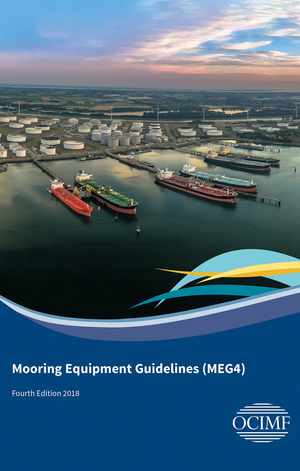
Mooring a ship to a berth is a common function for the maritime industry, however, incidents that harm ship and terminal personnel still occur. This book contains information on mooring system design and operational considerations, centring its guidance on the human factor and crew safety.
Listed as a relevant publication in IMO FAL.6/Circ.14/Rev.3 - 'List of Publications relevant to the ship/port Interface'.
Detailed Overview
This publication establishes the recommended minimum requirements that will help ship and terminal designers, ship operators and mooring line manufacturers on safe mooring system design, with an emphasis on the safety of ship and terminal personnel.
This fourth edition has been extensively updated and addresses lessons learned from incidents such as failures of HMSF mooring lines. It also reflects industry developments – the move towards human-centred design principles and human factors in mooring operations are explored in depth. New regulations from the IMO on the safety of mooring and options of alternative mooring technologies are also outlined.
Introduction
The Oil Companies International Marine Forum (OCIMF) first published Mooring Equipment Guidelines in 1992, with revised editions in 1997 and 2008. The revisions addressed changes in the design of terminals and ships, advances in mooring line or equipment technology and concerns arising from incidents or operating experience.
Mooring a ship to a berth remains a basic function for the maritime industry. A wide range of standards, guidelines and recommendations are available for mooring systems, from mooring equipment and arrangements to mooring practices. However, incidents that harm ship and terminal personnel still occur during mooring. OCIMF has undertaken a major revision of the Mooring Equipment Guidelines in this fourth edition, with a focus on the safety of ship and terminal personnel. It addresses four significant areas of interest:
Lessons learned from incidents, most notably from failures of HMSF mooring lines.
Human-centred mooring designs and human factors in mooring operations.
New and in-development regulations and guidance from the IMO on the safety of mooring.
Alternative mooring technologies and how they can be incorporated safely into the design of mooring systems both for ships and terminals.
OCIMF is grateful for the support and contribution made by other shipping industry associations, equipment manufacturers, port and terminal associations and pilot
associations. OCIMF would also like to extend a special thank you to the following organisations that played a significant role in the sections with the largest changes and new content: Cordage Institute, Eurocord, International Association of Classification Societies (IACS) and Ship Builders Association of Japan.
Further, OCIMF would like to thank the Marine Accident Investigation Bureau (MAIB) for input and feedback during the development of this publication.
The main changes from the third edition include:
Four new sections:
Section two: Human factors.
Section nine: Berth design and fittings.
Section ten: Ship/shore interface.
Section eleven: Alternative mooring technology.
One new appendix:
Appendix B: Guidelines for the purchasing and testing of mooring lines and tails
New tools to help operators manage equipment and lines from design to retirement:
Line Management Plan (LMP).
Mooring System Management Plan (MSMP).
Updated and expanded guidance on mooring lines.
New terminology to describe the strength of mooring lines and equipment (see A note on new terminology).
Updated wind and current drag coefficients (Appendix A), which have been re-validated by a leading Classification Society from IACS. These are now considered the most up-to-date coefficients covering tankers in the size range of 16,000 DWT and above.
It is recommended that onboard mooring equipment and fittings, including mooring lines, are identified as critical equipment or systems. OCIMF defines safety critical equipment as an individual piece of equipment, a control system or an individual protection device which in the event of a single point failure may:
Result in a hazardous situation that could lead to an accident.
Or
Directly cause an accident that results in harm to people or the environment.
Alternatives to the recommendations in this publication should only be introduced on the basis of a risk assessment and should be implemented through a proper management of change process. Any mitigation measures or contingency plans should consider the environmental limits for mooring, stopping cargo transfer and departing the berth.
This publication establishes recommended minimum requirements that will help ship designers, terminal designers, ship operators and mooring line manufacturers improve the design, performance and safety of mooring systems. To make sure improvements in mooring system design are implemented as soon as possible in the industry, it is recommended that:
New ships and terminals are designed and built using the recommendations in this publication.
New ships already under construction and existing ships consider making changes that will use the recommendations in this publication.
If new build ships under construction or existing ships are unable to follow the recommendations in this publication, they should, as a minimum, develop a Mooring System Management Plan (MSMP) and a Line Management Plan (LMP) that will:
Remain on the ship throughout its life as part of the management of change records.
Identify a timeline and measures needed to follow the recommendations of this publication.
Detail interim measures taken to address the recommendations in this publication, with reasons given for why the changes have not been implemented yet.
Where a terminal is already in service, the terminal management should perform a gap assessment with the recommendations in this fourth edition of the Mooring Equipment Guidelines and, where there are gaps, perform a documented risk assessment to ensure these gaps are appropriately managed in accordance with the site’s risk management guidelines to reduce risk and enhance safety. For new build terminals under consideration, or engineering not yet completed, where applicable, consider and implement the recommendations in the fourth edition of MEG.
This publication is aimed primarily at the hydrocarbon and chemical industry sectors,
conventional tankers, gas carriers and the terminals they visit. Many of the guidelines and recommendations in this publication could also be applied to non-conventional tankers and terminals such as Floating (Production) Storage and Offloading units (F(P)SOs) and Floating Storage and Regasification Units (FSUs), particularly where they interface with conventional tankers. In addition, some of the guidance and recommendations can be considered to be equally applicable to other industry sectors and non-tanker ship types.
With the publication of this edition, the following documents have been superseded and are removed from distribution:
Books:
Mooring Equipment Guidelines, Third Edition (MEG3).
Effective Mooring, Third Edition.
Information papers:
Potential Hazards Associated with Requests for Additional Mooring Lines by Terminal Operators.
Winch Brake Bands Design Considerations Impacting on Reeling Direction Guidelines for Specification of Manufacture, Testing, Procurement of High Modulus Polyethylene Ropes.
Summary of the Results of the MARIN Study to Validate the Adequacy of SPM Mooring Equipment Recommendations.
Lloyd’s Register Risk Assessment of Emergency Tow-off Pennant Systems (ETOPS) Onboard Tank Vessels.
Recommendations for Alternatives to Traditional Emergency Tow-off Pennants.
Contents Listing
Glossary
Abbreviations
Bibliography
A note on new terminology
Introduction to the Mooring System Management Plan and the Line Management Plan
Section one – Introduction to mooring
1.1 General
1.2 Objectives
1.3 Forces acting on the ship
1.4 Mooring system design principles
1.5 Stiffness of lines
1.6 General mooring guidelines
1.7 Operational considerations
1.8 Ship mooring management
1.9 Mooring System Management Plan
Section two – Human factors
2.1 Introduction
2.2 Safety critical task analysis
2.3 Human-centred design
2.4 Operations and maintenance
2.5 Competence and training
2.6 Health and wellbeing
Section three – Mooring forces and environmental criteria
3.1 Introduction
3.2 Standard environmental criteria
3.3 Calculation of forces
3.4 Mooring restraint requirements
3.5 Site-specific environmental data and mooring line loads
Section four – Mooring arrangements and layouts
4.1 Introduction
4.2 Piers and sea islands
4.3 Bow mooring at offshore terminals
4.4 Multi buoy moorings
4.5 Towing
4.6 Transits of canals and waterways
4.7 Emergency tow-off pennants
4.8 Barge and small ship mooring
4.9 Ship to ship transfers
4.10 Arrangements at cargo manifolds
4.11 Mooring augmentation in exceptional conditions
4.12 Combination of various requirements
4.13 Equipment and fitting line-up with operational considerations
Section five – Mooring lines
5.1 Introduction
5.2 Mooring system design and line selection
5.3 Factors influencing mooring line performance
5.4 Maintenance, inspection and retirement
5.5 Steel wire ropes
5.6 High modulus synthetic fibre lines
5.7 Conventional fibre lines
5.8 Synthetic mooring tails
Section six – Mooring winches
6.1 Introduction
6.2 Selection and specification of mooring winches
6.3 Design and construction of mooring winches
6.4 Operation and maintenance of mooring winches
Section seven – Mooring and towing fittings
7.1 Introduction
7.2 Selection and specification of mooring and towing fittings
7.3 Design and construction of mooring and towing fittings
Section eight – Structural reinforcements
8.1 Introduction
8.2 Design considerations
8.3 Mooring winches
8.4 Fairleads
8.5 Pedestal fairleads
8.6 Bitts
8.7 Recessed bitts
8.8 Bow chain stopper fittings and Smit towing brackets
8.9 Special considerations for installation
Section nine – Berth design and fittings
9.1 Introduction
9.2 Berth mooring structure layout considerations
9.3 Performing mooring evaluations and assumptions
9.4 Establishing environmental operating limits
9.5 Types and application of berth mooring equipment
9.6 Operational considerations for design of berth mooring equipment
9.7 Berth mooring equipment and structural inspection and maintenance
Section ten – Ship/shore interface
10.1 Introduction
10.2 Ship operator responsibility
10.3 Terminal operator responsibility
10.4 Ship responsibility
10.5 Berth operator responsibility
10.6 Ship mooring personnel responsibility
10.7 Joint ship/shore meeting and inspection
10.8 Tug and line boat operations
10.9 Records of mooring operations
Section eleven – Alternative mooring technology
11.1 Introduction
11.2 Examples of alternative and emerging technologies
11.3 Due diligence process
Appendices – Appendix A: Wind and current drag coefficients
A1 Introduction
A2 Symbols and notations
A3 Wind and current drag coefficients for large tankers
A4 Wind and current drag coefficients for gas carriers
A5 Example force calculations for VLCC
Appendix B: Guidelines for the purchasing and testing of mooring lines and tails
B1 Introduction
B2 How to use these guidelines
B3 Stakeholders
B4 Documentation
B5 Base design process
B6 Purchasing process
B7 Base design manufacture
B8 Base design testing
B9 Product supply manufacture
B10 Product supply quality assurance testing
B11 Nonstandard testing
B12 Example documents
About the Author
The Oil Companies International Marine Forum (OCIMF) is a voluntary association of oil companies with an interest in the shipment and terminalling of crude oil, oil products, petrochemicals and gas. OCIMF focuses exclusively on preventing harm to people and the environment by promoting best practice in the design, construction and operation of tankers, barges and offshore vessels and their interfaces with terminals. Learn more at www.ocimf.org.